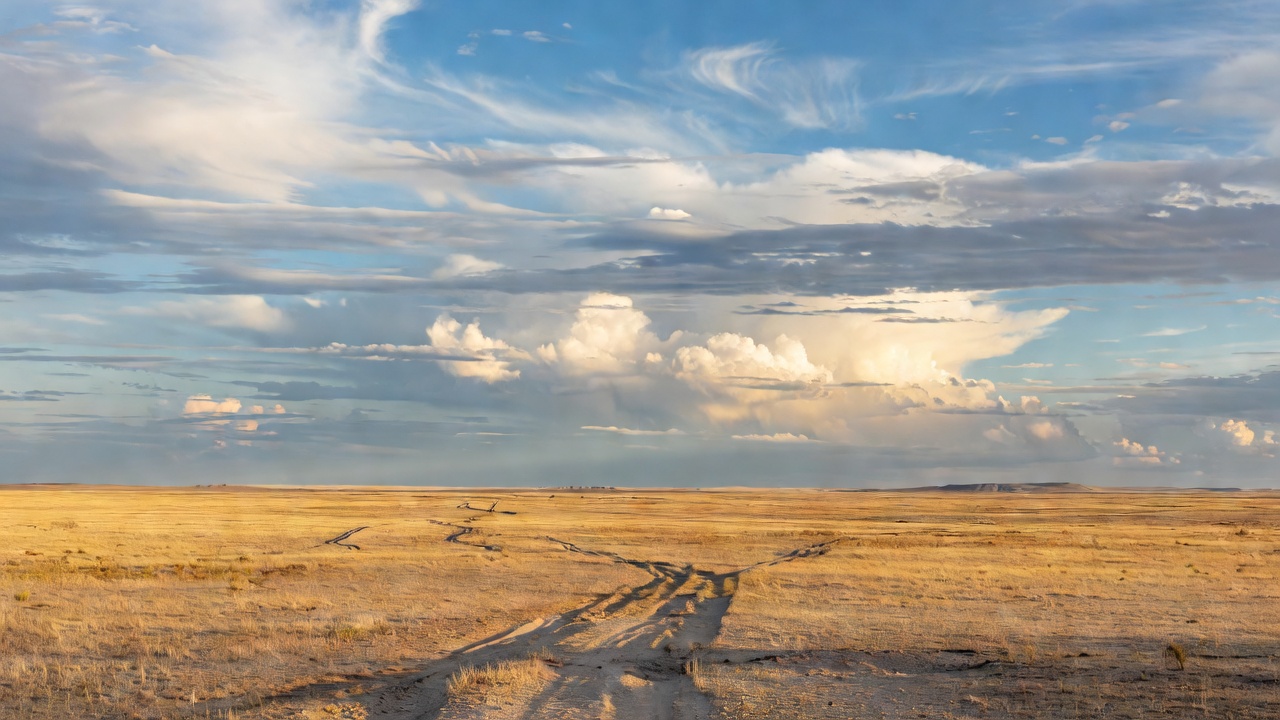
The open-land problem
In mountains and cities, structure is already stacked for you. In open landscapes, the land may offer only gentle undulation, texture fields and a horizon line. That emptiness is the point—and the difficulty. Viewers accept large negative space when the few elements present feel inevitable: a track curve, a lone structure on a public path line, a tonal break in grasses, a shadow moving with cloud. Random mid-frame clutter without hierarchy reads as unfinished rather than minimal.
Successful open locations usually provide one dominant plane relationship (land against sky), one secondary texture, and one intentional accent. If you cannot identify those on arrival, keep walking until the ground changes or the sky begins to organise light. Not every wide place is a photograph waiting to happen.
Sky as primary terrain
On low relief ground, weather is the co-author. Approaching fronts draw diagonal attention; post-frontal clarity sharpens distant edges; layered cloud creates soft ceilings that replace missing mountains. Learn to watch the horizon for tone changes and virga. A featureless blue sky can still work with strong ground pattern—but you will lean harder on foreground design and careful horizon placement.
Horizon height is a decision, not a default. Lower horizons emphasise sky narrative; higher horizons emphasise ground texture and can suit dune ripples or agricultural patterning. Keep horizons level unless a deliberate tilt serves a known graphic intent. Slight undulations become more legible when side-light rakes them; overhead sun often kills the micro-relief that open land depends on.
Foregrounds without clutter
Walk until you find a lead that belongs to the place: a public footpath, fence line you may photograph from a right of way, drainage cut, boardwalk, or natural dune crest. Avoid damaging vegetation to “shape” a foreground. In fragile dune and heath systems, stay on established routes even if that means a simpler composition. Sustainability is part of location craft, not an afterthought printed in a caption.
Get low carefully to lift small textures—seed heads, cracked mud, wind patterns—but check for moisture and wildlife. A low angle that loses the horizon’s clean line can reintroduce the hierarchy problem. Sometimes the strongest minimal frame is taken from standing height with ruthless simplicity and more space than feels comfortable in the moment.
Scale markers and human absence
Open scenes can lack scale. A distant vehicle on a public road, a walker on a right of way, or a known tree cluster can fix size. Equally, pure absence can be the subject if texture gradients are strong. Decide deliberately. Including people changes the genre toward environmental narrative; excluding them pushes toward formal landscape. Both are valid when chosen rather than accidental.
Be cautious with isolated buildings on private land. Photographing from public paths is often lawful in many regions, but access to yards or climbing walls is not. Telephoto compression from a legal stance can separate structure from clutter without entering. Always prioritise local access norms and signage.
Kit and exposure notes for wide light
Open land means wind. Tripods need stable legs and sometimes a hanging bag for ballast—without damaging soft ground. Lens choice often sits between moderate wide for environmental context and mild telephoto for pressure on a single accent. Ultra-wide emptiness can look accidental unless the sky itself is highly structured.
Dynamic range swings hard when bright cloud sits over dark soil after rain. Expose to hold the sky you care about, or wait for a cloud shadow to even the ground. Graduated filters can help in-camera balancing on simple horizons; complex tree lines make optical grads less elegant than careful exposure and restrained processing. Keep saturation modest—open landscapes punish heavy-handed colour quickly.
Pros, cons and category choice
Pros: shorter approaches than high mountains in many regions; sky-driven variety from a single stance; strong seasonal colour in grasses and crops; excellent training ground for composition discipline.
Cons: exposure to wind and weather with little shelter; fragile surfaces that limit foot placement; scenes that collapse without good light; fewer “automatic” depth cues.
Choose open landscapes when you want weather, horizon and minimal anchors to carry the frame. Choose coastal headlands when you need water motion and recession along a solid edge. Choose woodland for layered intimacy. Many photographers alternate open-land sessions with denser environments so that minimal habits stay sharp without becoming a single default aesthetic.
A repeatable field method
On arrival, stand still and name the accent aloud. If you hesitate, move. When you find it, lock a horizon decision, then test two distances—closer for texture dominance, further for sky dominance. Shoot a sequence as weather shifts rather than a single frame. Leave with notes on wind direction, access limits and where the ground pattern improved. Open land rewards repetition: the same public track under different fronts can teach more than constant novelty hunting.
Mediamiclipcottag frames open landscapes as a test of judgement. When sky, accent and surface agree, the quietest places become some of the clearest photographs you can make.